TradingKey - Caterpillar (CAT) enters October with demand widening across construction, mining, and power generation. With the ongoing AI infrastructure buildout, CAT is well positioned to benefit as an indirect participant. The stock closed at $813.83 on October 7, down 5.75% on the day due to broad-based sector selling. CAT remains substantially higher for the year.
The strength and broad-based nature of the current cycle is impressive. Caterpillar is benefitting from more than one end market. Construction Industries is strong, aided by Infrastructure Investment and Jobs Act funds. Resource Industries is improving, as is Power & Energy, which benefits from growing demand for power generation and other related equipment. The question is whether the strength can offset rising costs and higher investor expectations.
October 29 Earnings Are the Next Major Catalyst
Caterpillar’s published 2026 earnings schedule shows third quarter earnings on October 29, with management’s call set for 8:30 a.m. ET. That report should provide the first evidence of whether the record-breaking second quarter momentum is sustained in the second half of 2026.
While I’m mostly interested in backlog and Power & Energy orders this quarter, Construction Industries orders and segment margins remain critical. I’ll be looking for concrete indications of order momentum beyond revenues and cash conversion. The recent significant re-rating of the stock has increased the expectations for the third quarter.
The 7th of October selloff certainly adds a sense of urgency to this. The stock sold off after the FTC and USDA announced a sector-wide agricultural equipment inquiry into antitrust and competitor practices. While Caterpillar was not named in the inquiry, I see this as more of a sentiment and regulatory overhang issue that doesn’t necessarily impact the core of Caterpillar’s operational story.
Off-Grid Power Highlights a Broader Opportunity
Caterpillar announced an off-grid gas power project to provide a remote gold mine in Kazakhstan with continuous prime power on October 7. West Gold Mining selected two Cat G3500K series gas generator sets from Caterpillar and Borusan Cat, a Caterpillar dealer, for the project. The mine is located 300 kilometers from the nearest city and is without access to the power grid.
Individually, these projects are not financially material. However, use cases like these demonstrate areas where the electrical grid is not keeping up with the demand for reliable power and where Caterpillar can win projects. One such area is mining. Caterpillar is also targeting power needs of data centers and industrial customers.
Electrification of the AI buildout means the development of data centers, edge locations and 5G towers to name a few, will create even greater need for power that can be satisfied by immediate and reliable sources outside the grid.
Power & Energy Is Becoming a Major Growth Engine
Sales in the Power & Energy segment reached $8.24 billion in Q2, an increase of 17% over the prior year. Segment profit increased 30% to $2.03 billion as higher volume and pricing offset manufacturing costs.
There are signs the external sales mix has started to change to reflect Caterpillar’s position in the AI infrastructure cycle. Power & Energy sales in North America increased significantly and were also reflected in Caterpillar’s retail sales of power generation equipment, which also increased.
Ultimately, the type of business that Caterpillar is benefitting from is the most important consideration. The AI demand cycle is being benefitted by a business that already has appealing margins and is benefitted by Caterpillar’s installed base and aftermarket services.
Construction Industries Is Growing Even Faster
Construction Industries was Caterpillar's fastest growing major segment in Q2, with total sales increasing 35% to $8.35 billion and segment profits up 57% to $1.95 billion.
Growth in the North American segment was impressive as a result of higher end user demand, changes in dealer inventory, and construction related to data centers and infrastructure. With regard to data center construction, Caterpillar can also benefit as there is earthmoving and construction related to the infrastructure to support data centers.
This broader view that construction-equipment demand is durable was reinforced by Caterpillar on September 30 when the company announced a $1 billion investment to build a facility in North Carolina to manufacture compact track loaders and telehandlers. Management indicated they expect continuing and rising demand for these products, and given the build out and expansion of the Caterpillar manufacturing facility, they expect long lasting customer demand.
The $1 Billion North Carolina Investment Signals Confidence
Caterpillar sees customer demand and orders for compact track loaders and telehandlers to be sustained, and durable, and not part of a short cycle, and so the expansion makes sense. This is particularly the case with the incorporation of various digital and advanced manufacturing systems and the integration of automation.
Fixed investments in manufacturing are amortized (recovered) over a long period of time, and the product being manufactured is expected to be sold to customers for that period. Given the nature of the equipment, the demand must be sustained for the product. Long term customer demand for equipment is what justifies investment in fixed equipment.
For shareholders, the risk is timing. A large manufacturing expansion can put a squeeze on returns if construction demand does not keep pace with the new capacity. Currently the order environment is improving and gives management more confidence than previously.
Q2 Was Caterpillar’s First $20 Billion Quarter
Caterpillar announced Q2 sales and revenues of $20.5 billion, the first time in company history sales exceeded $20 billion, and a 24% increase from the same period last year. Adjusted profits per share were $8.17, up 73% from the prior year.
There was substantial operating leverage. The positive impact from increased sales volume was evident throughout the organization. Improved profitability was evident throughout the Construction Industries and Power & Energy segments.
What I found most interesting was the breadth of the quarter. Strong order rates were evident throughout all of the company’s major operating segments, supporting the thesis that Caterpillar is benefiting from multiple spending cycles.
Backlog Provides Unusually Strong Visibility
Caterpillar ended Q2 with backlog at roughly $72.1 billion, up from approximately $62.7 billion at the end of Q1, due to about $9.4 billion in new orders in the quarter. Management said order activity was strong in Power & Energy, Construction Industries and Resource Industries.
Caterpillar has more visibility into the future than it has historically. Additionally, because a greater level of future demand is represented by firm orders, there is less reliance on dealer inventory to satisfy future demand.
The real question is, can Caterpillar convert firm orders into actual equipment shipments while retaining or improving its pricing to offset supply chain and/or manufacturing costs? If Caterpillar fails to do either, margins will likely suffer.
Mining Demand Is Improving Too
Resource Industries sales increased 20% year-over-year to $4.65 billion in Q2. Demand for mining and heavy construction and quarry and aggregates improved, and resource industries operating profit increased due to volume and pricing improvements that offset higher manufacturing costs.
Autonomous haulage is another aspect of Caterpillar’s value proposition. Caterpillar and Luck Stone extended their autonomous haulage pilot after the first phase resulted in 3.5 million tons of material moved in 18 months.
This type of technology can deepen Caterpillar’s relationships with its customer by providing software, service and technology support, potentially making the Resource Industries business less reliant on infrequent, large equipment purchases.
Tariffs Remain the Main Margin Risk
From Caterpillar’s perspective, tariffs remain the largest identifiable cost headwind. Per the company’s 2Q report, Caterpillar recognized approximately $392 million of expected IEEPA tariff recoveries, which benefited operating profit.
Management expects that 2026 full-year tariffs will be approximately $2.2 billion. While this is at the lower end of previous expectations, it is large enough to affect segment margin and overall pricing.
This is one of the most important numbers to watch on October 29. Tariff costs have so far primarily been absorbed by pricing, volume and recoveries. Continued increases in tariff-related manufacturing costs may make the current margin structure untenable.
Cash Generation Supports Shareholder Returns
Caterpillar reported healthy operating cash flows for the second quarter. Management also returned $2.2 billion to shareholders through dividends and buybacks. Entering the quarter with strong cash flows provided the company flexibility to return capital while investing for growth.
The board of directors also approved a quarterly dividend of $1.63 per share, which increased the annual dividend for a record 32nd consecutive year. Given the dividend and buyback policy, management expects to return the majority of the free cash flows generated by the Machinery, Power & Energy segments to shareholders.
Paired with continued backlog growth, there is a stronger case where tariff costs can continue to be absorbed, capacity and equipment expansion can be funded, and share count reduced.
Valuation Leaves Less Room for Disappointment
At the recent close, Caterpillar's market cap was approximately $374 billion. The multiple reflects expectations that strong AI-related power demand, infrastructure and mining/construction spending will continue to drive strong earnings.
With the shares trading at these lofty multiples, expectations are for outperformance, and execution risk is greater compared to when CAT traded at a lower multiple.
At current levels, the valuation supports expectation for continued strength in Power & Energy orders, continued strength in Construction Industries demand and backlog. Sharp deterioration in margins would change the multiple quickly.
A slowdown in data center projects or weaker construction spending could also represent a negative catalyst for the stock. Disappointing results during earnings would also increase the multiple quickly.
Caterpillar Technical Analysis: CAT Tests $808.55 Support as Sharp Selloff Threatens Recovery
Caterpillar closed at $813.83 on October 7, having been rejected from the $860 to $870 region, and giving back much of its recent advance. What attracts my attention is the bearish daily candlestick that broke CAT below both moving averages and retested the rising trendline and critical support at $808.55. This is a critical test of the recovery from the September lows.
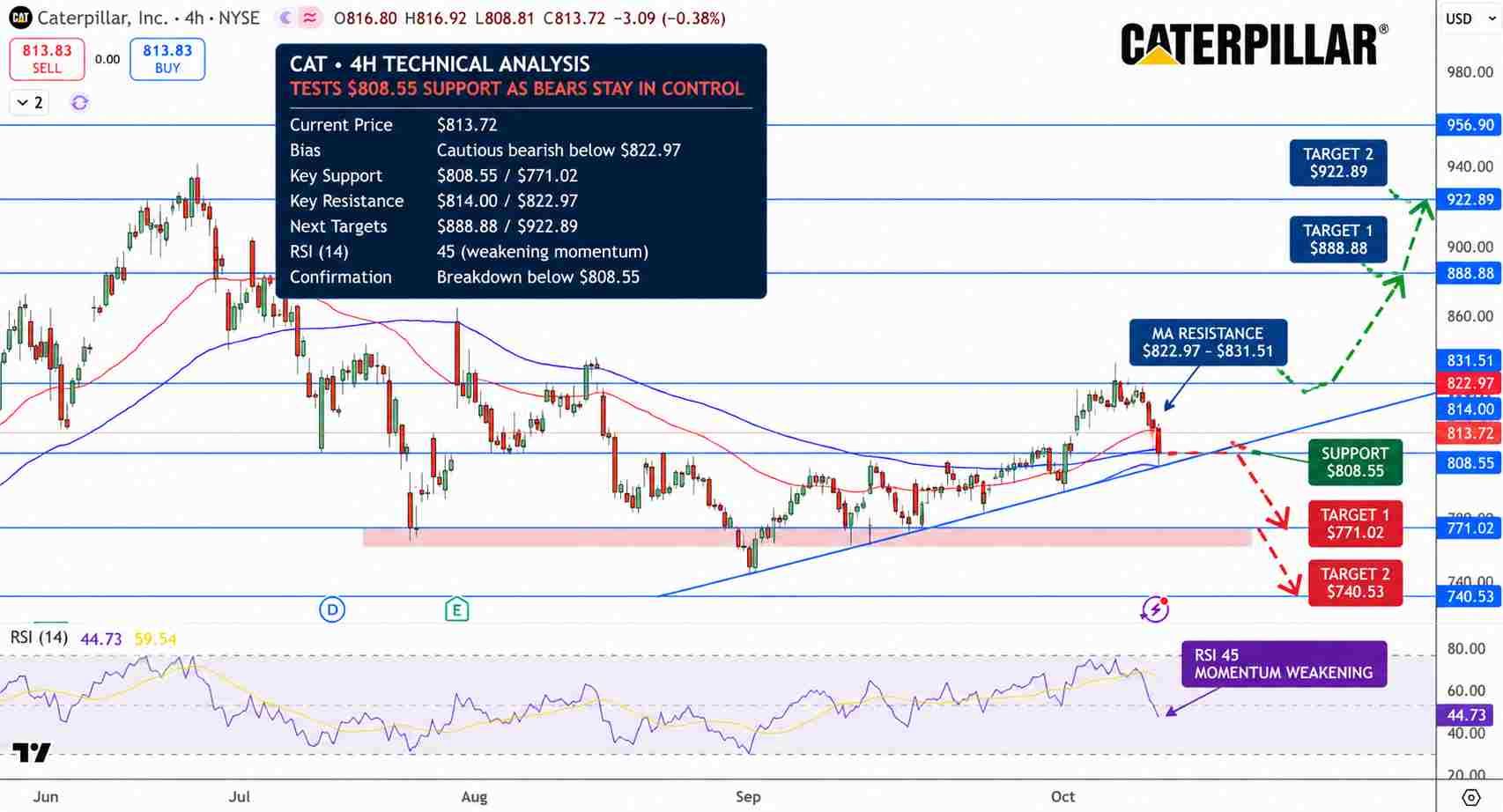
Caterpillar Stock Price Chart - Source: Tradingview
RSI is around 45 and is below its signal line near 60 after recently approaching overbought territory. The rising trendline, however, could still attract buyers.
Immediate support is at $808.55. A break and close below this support and rising trendline would increase the risk of a test of the $771.02 demand area. Further liquidation could retest $740.53.
The rising trendline remains intact, but the price is below the moving averages near $822.97 to $831.51, keeping the short-term bias bearish, with resistance at $814.00 and $888.88. A close above $831.51 would improve the bias. My bias remains bearish while Caterpillar trades below $822.97 to $831.51.
Key Levels
• Latest completed close: $813.83
• Major support levels: $808.55, $771.02, then $740.53
• Major resistance levels: $814.00, $822.97 to $831.51, then $888.88
• RSI: approximately 45, weakening
• Recovery trigger: sustained move above $831.51
• Breakdown trigger: sustained 4-hour close below $808.55
Why is Caterpillar stock in focus now?
Caterpillar is in the spotlight because the company reported record revenue in Q2, and all three of their segments showed growth. The company reported a backlog of orders of almost $72 billion. The Power & Energy segment is benefiting from the power needs of the data centers and other off-grid power facilities. Caterpillar is benefiting from multiple growth segments beyond the traditional power segment of mining and construction.
What level confirms a stronger CAT recovery?
A move and close above $831.51 would show that the moving average resistance cluster has been taken out and would improve the short-term picture. A close below the rising trendline and $808.55 would show a decline from the rising trendline and focus on the $771.02 area.
Bottom Line
Caterpillar begins October with multiple segments of the industry showing growth. Construction, Power & Energy and Resource Industries are all showing growth, and Caterpillar's Q2 sales topped $20 billion for the first time. Backlog is at record levels. AI infrastructure is adding a source of demand through construction of data centers and other power facilities.
There are a few risks, primarily valuation, and execution. At $800, the stock is pricing in a long multi-year growth cycle, and Caterpillar is currently trading near the lower end of its support zone, and the October 29 earnings report will show whether backlog orders and power demands remain strong.
Find out more