TradingKey - The U.S. Treasury may deploy $950 billion from the Treasury General Account (TGA) to support Treasury buybacks, causing U.S. Treasury yields to retreat from high levels. However, Trump's warning to raise tariffs on Canadian automobiles to 50% dampened market sentiment. The three major U.S. stock indices ended mixed, with AI hardware stocks sold off and memory stocks leading the declines.
At the close, the Dow Jones Industrial Average rose 0.26% to 53,417.16; the Nasdaq Composite Index fell 0.76% to 25,980.19; and the S&P 500 Index dropped 0.28% to 7,652.86.
Tech Stock Performance
Broadcom (AVGO) fell 2.63% to $358.76.
Broadcom's credit risk rises as financing guarantees for AI chips fuel bond market concerns. The yield on a Broadcom bond with a 5.15% coupon maturing in 2031 has risen by about 14 basis points since August, signaling pressure on bond prices. Meanwhile, the company's 5-year credit default swap (CDS) spread widened by about 28 basis points over the same period, surpassing increases for Oracle and SpaceX. Broadcom is currently negotiating a debt financing deal exceeding $60 billion with financial institutions to help AI companies, including Anthropic, purchase chips and related infrastructure. While the transaction structure remains under discussion, Broadcom may provide credit support for a portion of the senior secured debt.
Among mega-cap tech stocks, Meta Platforms (META) rose 1.66%, Amazon (AMZN) gained 1.33%, Google (GOOGL) advanced 0.94%, Microsoft (MSFT) climbed 0.84%, and Apple (AAPL) added 0.32%; on the downside, Tesla (TSLA) fell 3.81%, Nvidia (NVDA) dropped 2.91%, Broadcom (AVGO) fell 2.63%, TSMC (TSM) slipped 2.11%, and SpaceX (SPCX) lost 1.44%.
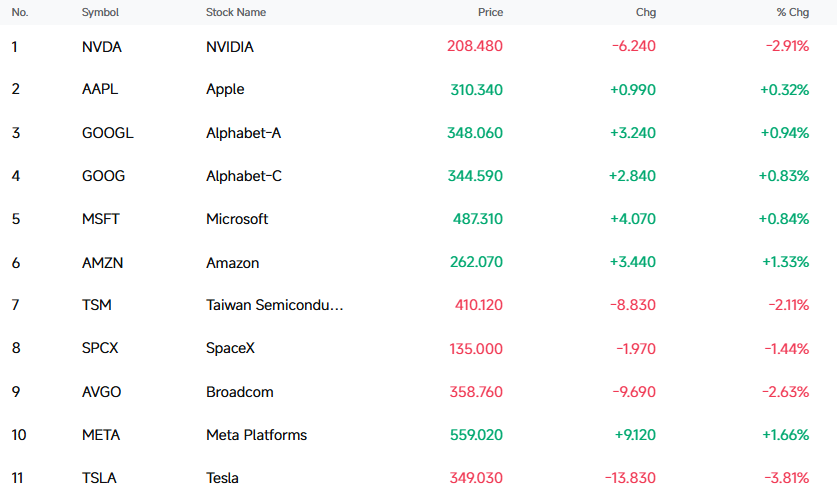
[Source: FutuBull]
The Philadelphia Semiconductor Index fell 2.7% to 11,423.17 points, with all 30 constituents closing lower. Among them, AMD (AMD) dropped 3.49%, Intel (INTC) fell 3.12%, TSMC (TSM) slipped 2.07%, Arm Holdings (ARM) fell 1.87%, Applied Materials (AMAT) dropped 1.65%, and ASML (ASML) lost 1.34%.
Among memory stocks, Seagate Technology (STX) fell 6.51%, SanDisk (SNDK) dropped 6.45%, Micron Technology (MU) fell 5.83%, Western Digital (WDC) dropped 5.24%, and SK Hynix (SKHY) slipped 4.92%.
Company News
Nvidia Vera CPU Adopted by SpaceXAI
Nvidia announced on Monday that SpaceXAI, the artificial intelligence division of SpaceX, will deploy Nvidia Vera CPUs to develop and run next-generation agentic AI applications. The chip will be used across multiple projects, including the Grok chatbot, helping handle tasks across tool calling, code execution, data analysis, and model inference, thereby reducing response times for AI agents.
Alibaba Chairman Joe Tsai and CEO Eddie Wu Increase Shareholding by Combined HK$120 Million Approximately
Following Alibaba's announcement of an HK$80 billion new share placement plan, Group Chairman Joe Tsai and CEO Eddie Wu bought a combined total of approximately HK$120 million in Alibaba shares. The placement was reportedly nearly 3 times oversubscribed, attracting over HK$200 billion. Sovereign wealth funds and long-only funds accounted for over 40% of the final allocation. Major sovereign wealth funds from regions including the Middle East, Europe, and Asia actively participated in the subscription.
Tesla to Launch Production Version of Cybercab on September 3
Tesla is set to launch the production version of the Cybercab on September 3. The Cybercab reportedly has no steering wheel or pedals. It is Tesla's first vehicle designed entirely for autonomous driving, intended to run the company's Full Self-Driving (FSD) software as part of the robotaxi fleet Tesla unveiled in Austin last year, which also includes modified Model Y vehicles.
Industry & Macro News
Bessent to Take Aggressive Action to Push 10-Year US Treasury Yield Toward 5%
According to a Fox Business reporter, Wall Street executives said US Treasury Secretary Scott Bessent is preparing to take aggressive measures to push the 10-year US Treasury yield closer to 5%. Options under consideration include Treasury bond buybacks, increasing short-term Treasury bill issuance, and potentially eliminating 20-year Treasury bonds. Wall Street executives noted that the Trump administration is not expected to pursue austerity policies, but instead hopes to rely on increasing tax revenue to resolve debt issues through economic growth.
US-Canada Trade Talks Collapse as Trump Warns of Raising Tariffs on Canadian Automobiles and Auto Parts to 50%
Expectations of a de-escalation in US-Canada trade rapidly reversed as the tariff dispute escalated once again. The Trump administration officially pressured Canada on Monday, announcing that following the breakdown of negotiations over the weekend, tariffs on all categories of Canadian complete vehicles and auto parts will be raised to 50%—effectively doubling the current rate—set to officially take effect on January 1, 2027. Negotiations between the two sides had previously been close to reaching a temporary de-escalation: the US proposal planned to lower tariffs on sedans and light trucks from 25% to 15%, and steel and aluminum tariffs from 50% to 25%. However, final negotiations stalled on a core disagreement: whether medium- and heavy-duty trucks should be included in the tariff relief scope. The failure to reach a consensus on this issue directly led to the complete collapse of the entire agreement.
Wall Street Believes US Treasury Buybacks Are Unlikely to Reverse Rise in Long-End Yields
Strategists at Wall Street firms such as Goldman Sachs and Wells Fargo stated that while the US Treasury Department's expansion of long-term Treasury buybacks may temporarily ease market volatility, it is unlikely to reverse the upward trend in long-term Treasury yields. Following the Treasury's announcement to expand the buyback program, 10-year and 30-year Treasury yields temporarily fell rapidly. However, yields subsequently moved higher again. Market participants believe that buyback measures alone do not solve fundamental issues such as the widening US fiscal deficit, rising inflationary pressures, and increasing supply of long-term Treasuries.
Goldman Sachs strategists George Cole and William Marshall stated in an August 21 report that increasing long-end buybacks does not address the main driver of recent long-term yield volatility, and even a further expansion of scale is unlikely to significantly alter interest rate levels. Meanwhile, a team led by Wells Fargo strategist Erik Nelson believes that pushing long-end yields down in a sustained manner would require supporting macroeconomic factors, including slower economic growth and inflation, reduced uncertainty surrounding the Federal Reserve's balance sheet and interest rate policy, fiscal consolidation, or a slowdown in the pace of investment-grade corporate bond issuance.
Find out more