TradingKey - According to a report by The Information citing people familiar with the matter, Nvidia (NVDA) is in talks to participate in a new funding round for Perplexity at a valuation of over $30 billion. If completed, the deal would be one of its largest investments in the AI application layer, signaling that the chipmaker is attempting to expand from a hardware supplier to an AI ecosystem leader.
The market's focus is shifting from Nvidia's chip sales capabilities to whether the company can build a sustainable business model beyond hardware, and how this strategic investment will impact Nvidia's stock price.
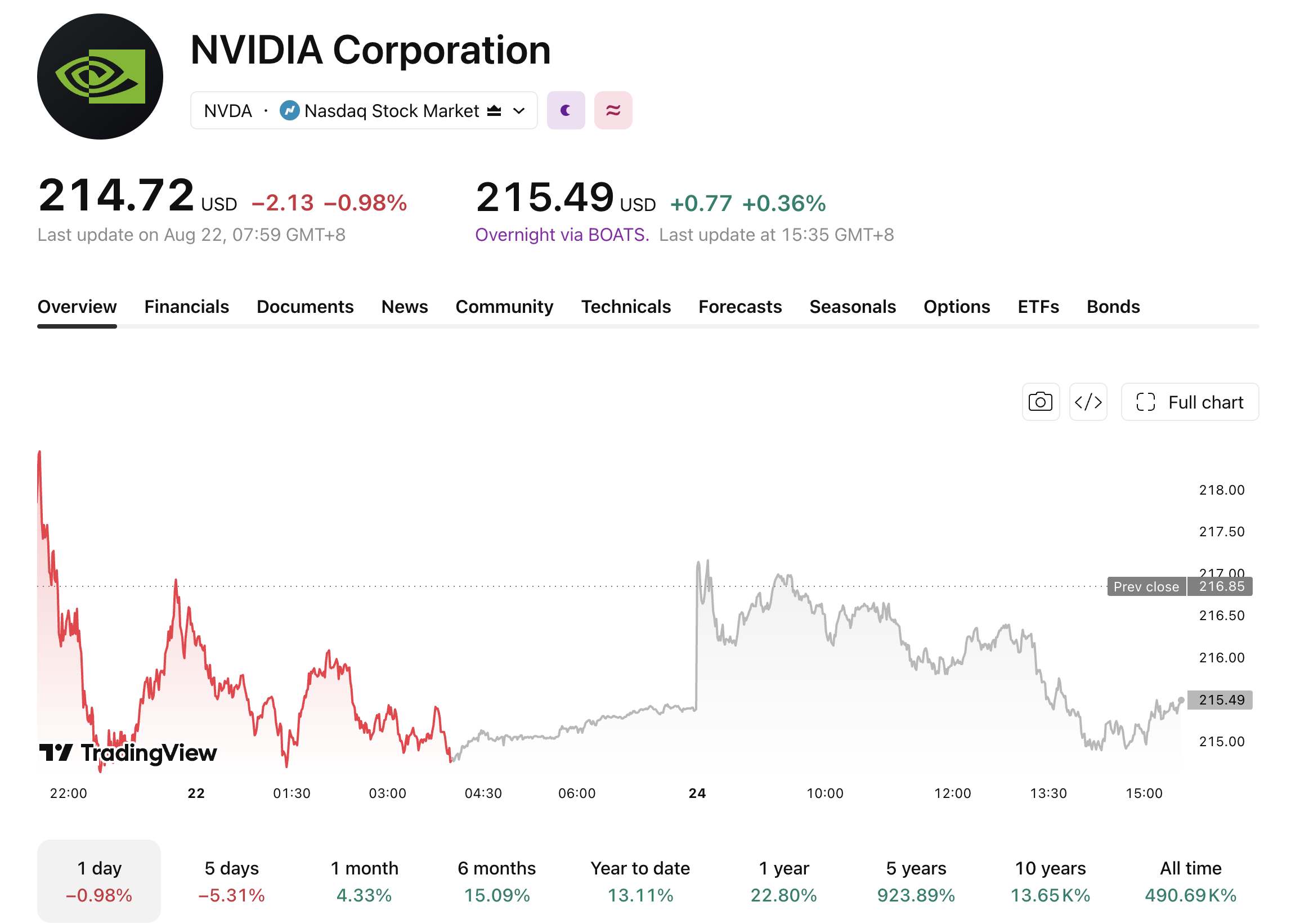
[Source: TradingView]
What Kind of Company Is Perplexity?
Perplexity was founded in San Francisco in August 2022. Its core product is a conversational "answer engine" that combines large language models with real-time data retrieval to directly deliver verifiable answers to users, distinguishing it from the list of links provided by traditional search.
The company was co-founded by four co-founders, including former OpenAI and Google (GOOGL) DeepMind employee Aravind Srinivas, as well as former Microsoft (MSFT) Bing and Quora employee Denis Yarats, among others.
To date, Perplexity has raised a cumulative total of more than $1.7 billion from investors such as Nvidia, New Enterprise Associates, Accel, and SoftBank. Following the completion of this funding round, its valuation has grown by over 50% from approximately $20 billion after its previous round a year ago, reaching more than $30 billion.
Why Nvidia Wants to Invest in Perplexity
Nvidia holds a dominant position in the AI training and inference chip market, but its revenue depends heavily on downstream application demand. As concerns mount over a slowdown in the growth of AI computing demand, Nvidia needs to ensure that its GPUs are not only purchased by a few hyperscalers, but are also embedded into broad enterprise and personal workflows.
As an AI search and agent platform connecting end users with underlying models, Perplexity serves as just such an entry point. Nvidia CEO Jensen Huang has publicly stated that he uses Perplexity on a daily basis.
For Nvidia, investing in Perplexity means securing a foothold in the high-traffic scenario of AI search, while expanding the application scope for its self-developed AI models and software ecosystem.
In addition, Perplexity's inference business relies on GPU computing power. In March this year, it reached a multi-year inference agreement with Nvidia-backed CoreWeave (CRWV) and plans to adopt Nvidia Vera CPUs, thereby directly linking Nvidia's investment to computing demand.
Nvidia's Investment Footprint Continues to Expand as "Circular Financing" Controversy Heats Up
Nvidia's investment footprint has long extended beyond the scope of traditional venture capital. According to reports, in late 2025, the company reached an agreement with U.S. AI chipmaker Groq to license its technology and absorb its engineering team; in 2026, it paid $6 billion to license Poolside's AI model development software while investing another $1 billion; a similar pattern has also emerged with companies such as Enfabrica.
Meanwhile, according to previous media reports, Nvidia has committed to making substantial investments in leading AI companies such as OpenAI and Anthropic, though the exact amounts have not been publicly confirmed.
Together, these transactions paint a corporate footprint that extends far beyond the chip business: Nvidia is no longer merely a hardware vendor, but a central node connecting computing power, software, models, and customers.
However, this has also raised questions about "circular financing," as capital deployed by Nvidia often flows back in the form of chip orders or cloud services, suggesting that the revenue growth on its financial statements may partially stem from the recycling of its own capital rather than purely independent end demand.
When investments, sales, and valuations become intertwined, it becomes difficult for the market to determine whether Nvidia's rapid growth is driven by genuine AI demand or by its self-built financial recycling ecosystem.
How Will This Deal Impact Nvidia's Stock Price?
Supporters believe that by forging capital ties with key customers like Perplexity and OpenAI, Nvidia is poised to transform one-time chip sales into long-term partnerships that extend into software services and investment returns, thereby providing a more stable revenue stream for its current high market capitalization.
Skeptics, on the other hand, point out that this financialization strategy simultaneously heightens risks. Large-scale external investments could impact shareholder returns, and if AI infrastructure spending slows down or downstream application revenues fall short of expectations, both the core chip business and the investment portfolio will face dual pressures.
More critically, Nvidia's overlapping roles as shareholder, supplier, and investor in its customers have already drawn scrutiny from U.S. and European antitrust regulators.
In the short term, this investment helps consolidate market confidence in Nvidia's AI strategic layout. However, the medium- to long-term trajectory hinges on one core question: whether downstream AI applications can convert expanding computing power into sustainable commercial revenue. If so, the business synergy model can endure; if the financing-investment cycle becomes unsustainable, the optimistic expectations embedded in the current share price will face a correction.
Find out more